

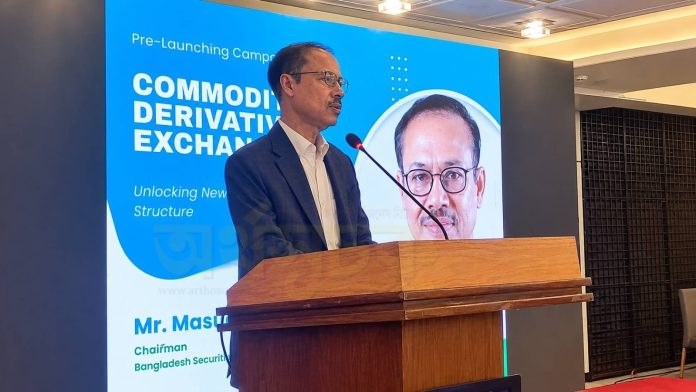
Gold, silver and crude palm oil are set to be introduced as new trading instruments in Bangladesh’s capital market through the Chittagong Stock Exchange’s (CSE) commodity derivatives market.
Initially, transactions in these commodities will be settled in cash rather than through physical delivery, Bangladesh Securities and Exchange Commission (BSEC) Chairman Masud Khan said on Thursday.
He made the remarks at an event marking the initiative to launch the CSE’s commodity derivatives market.
Masud Khan said Bangladesh’s capital market has traditionally been dominated by equity trading. Although bond trading was introduced several years ago, it has yet to gain significant momentum.
He stressed that the desired development of the capital market would not be possible by relying solely on share trading, making the introduction of new financial instruments essential. Derivatives trading has also become a necessity for expanding the market, he added.
Under the proposed commodity derivatives market, investors will be able to trade gold, silver and crude palm oil. The platform is expected to help establish benchmark prices for these commodities in the domestic market, which businesses, institutions, traders and retail investors can use as reference prices.
The BSEC is working to expedite the approval process for brokers, commodities, trading systems and other institutional requirements to facilitate the launch of the market, the chairman said.
Explaining the decision to introduce cash settlement initially, he said arranging physical delivery of large quantities of gold, silver and palm oil would be challenging. Therefore, transactions will initially be settled in cash. Physical delivery may be considered in the future as the market develops the necessary capacity.
The BSEC chairman also emphasised the need to raise investor awareness to ensure the success of the new market.
Around 90 per cent of investors in Bangladesh’s capital market are retail investors, many of whom lack sufficient knowledge about determining the intrinsic value of shares, he said. They need to be educated about relatively complex financial instruments such as bonds and derivatives. Brokers will also require proper training to operate in the new market.
He cautioned that the market could initially face a shortage of sellers despite having buyers, making the presence of strong market makers essential to maintaining trading activities.
Masud Khan said investors should not expect substantial trading volumes immediately after the launch of the derivatives market. Citing India’s Multi Commodity Exchange (MCX), he noted that it took nearly a decade for the platform to develop significant trading activity.
He stressed that developing Bangladesh’s commodity derivatives market would similarly require long-term planning, patience and sustained efforts.

