

Bangladesh is falling behind the global apparel market in shifting from cotton to non-cotton products, raising concerns over the country’s product diversification and competitiveness.
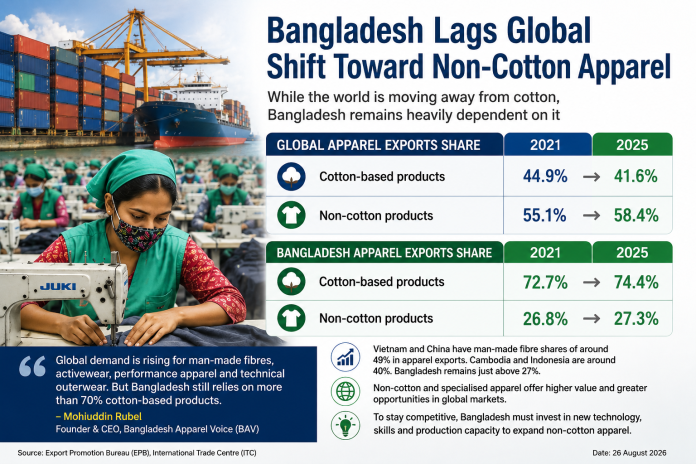
Data from the Export Promotion Bureau (EPB) and the International Trade Centre (ITC) show that cotton-based products accounted for 44.9% of global apparel exports in 2021, falling to 41.6% in 2025. Meanwhile, the share of non-cotton apparel rose from 55.1% to 58.4%.
Bangladesh, however, moved in the opposite direction. Cotton’s share of the country’s apparel exports increased from 72.7% in 2021 to 74.4% in 2025. The share of non-cotton products edged up only from 26.8% to 27.3%.
Mohiuddin Rubel, founder and CEO of Bangladesh Apparel Voice, said Bangladesh’s gap with the global market in non-cotton apparel widened from around 28 percentage points in 2021 to nearly 31 percentage points in 2025.
He said global demand is increasingly shifting toward man-made fibres, activewear, performance apparel and technical outerwear, while Bangladesh remains heavily dependent on cotton-based products.
According to Rubel, Vietnam and China have man-made fibre shares of around 49% in their apparel exports, while Cambodia and Indonesia are in the range of around 40%. Bangladesh’s non-cotton share remains just above 27%.
He stressed that non-cotton and specialised apparel also offer greater opportunities for higher-value exports. Bangladesh needs to increase investment in man-made fibre products, technology, skilled workers and production capacity to remain competitive.
“Price may help us win today, but capability will determine who wins tomorrow,” Rubel said, urging the industry to prepare for the changing demands of the global apparel market.

