

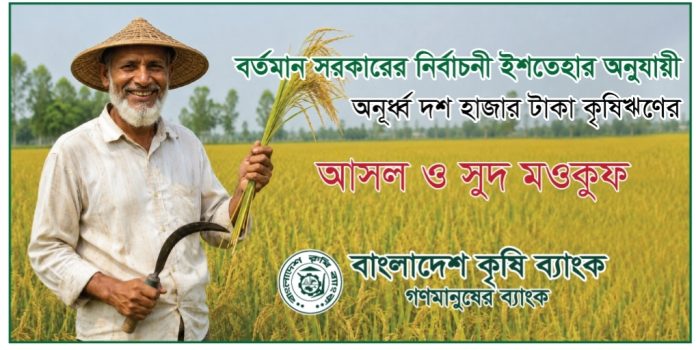
Bangladesh Krishi Bank Waives Agricultural Loans Worth BDT 6.05 Billion for 0.71 Million Farmers
In line with the present government’s election manifesto and as part of its farmer-friendly policy, Bangladesh Krishi Bank (BKB) has successfully implemented the agricultural loan waiver programme for loans up to BDT 10,000 to ease the debt burden of small and marginal farmers. Under this programme, agricultural loans of 709,679 farmers from different parts of the country have been waived. The total amount of waived loans stands at BDT 6,048,108,667. It is worth mentioning that Bangladesh Krishi Bank accounts for approximately 39% of the total amount of agricultural loans waived by the Government. For a long time, these small outstanding agricultural loans had been increasing the financial burden on farmers. In particular, natural disasters, rising production costs, sluggish market conditions and various financial challenges prevented many farmers from repaying their loans on time. As a result, a significant number of farmers were deprived of getting opportunity to receive fresh agricultural credit. Considering this situation, the Government decided to waive the principal and accrued interest on agricultural loans up to BDT 10,000. As part of implementing this decision, Bangladesh Krishi Bank completed nationwide data verification, account reconciliation and all necessary procedures to bring eligible farmers under the loan waiver programme. It is noteworthy that, in an agriculture-based Bangladesh, the bank alone disburses 63% of the country’s total agricultural loans. Through this initiative, a large number of small and marginal farmers have been relieved of their debt liabilities. In resulting, they will be able to access once again regular banking services and become eligible to get fresh agricultural loans for future farming. With the reduction of their debt burden, farmers will be able to concentrate on cultivation with renewed enthusiasm. Consequently, this initiative is expected to contribute positively to increased agricultural production, strengthened food security, improved financial capacity of farmers and will play a mentionable contribution in our rural economy.

