

B Mirror Report: Bangladesh remains insufficiently prepared to manage the economic impacts of its upcoming graduation from least-developed country (LDC) status, with major sectors such as banking, finance and manufacturing likely to face serious challenges, economists and business leaders warned on Tuesday.
The concerns were raised at a roundtable discussion as the United Nations’ certification deadline for Bangladesh’s status change draws closer. Participants cautioned that once the country officially graduates in November 2026, it will lose preferential trade benefits, concessional financing and policy flexibilities, increasing competition in global markets.
They stressed that without swift reforms and adequate preparation, the transition could place severe strain on the financial system and threaten macroeconomic stability.
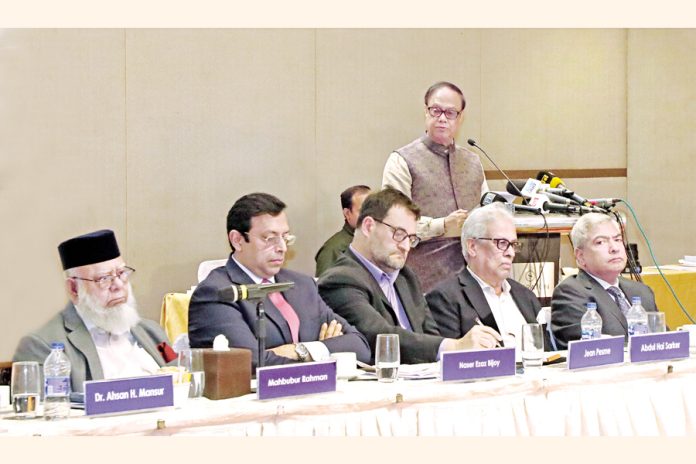
The roundtable, titled “Implications of LDC Graduation for the Banking Industry: Bangladesh Perspective,” was organised by the International Chamber of Commerce Bangladesh (ICCB) at a city hotel. ICCB President Mahbubur Rahman moderated the session, while Bangladesh Bank Governor Dr Ahsan H. Mansur attended as chief guest. Dr Shah Md Ahsan Habib of the Bangladesh Institute of Bank Management presented the keynote paper.
Speakers urged policymakers to prioritise competitiveness, institutional strengthening and export diversification to successfully navigate the post-LDC era.
Addressing the event, Governor Dr Mansur said Bangladesh’s development path and LDC graduation should be viewed as complementary rather than separate processes.
“Development and graduation must progress together,” he said, calling for long-term structural reforms to ensure sustainability.
He emphasised improving efficiency across the economy, upgrading logistics and transport infrastructure, and increasing investment in education and healthcare. The governor noted that development partners have already treated Bangladesh as a developing economy since 2015.
He also stressed restoring macroeconomic stability by controlling inflation and reducing interest rates, noting that historically inflation hovered around 6 to 7 percent but should be lowered to 2 to 3 percent to support sustainable growth.
Dr Mansur said better coordination and reforms could raise economic efficiency by up to 30 percent, adding that the interim government has already introduced several reforms, including the Bank Resolution Ordinance 2025, though further measures are still required.
Panel discussants included Mutual Trust Bank Managing Director Syed Mahbubur Rahman, Prime Bank CEO Hassan O. Rashid, Plummy Fashions Managing Director Md Fazlul Hoque, Picard Bangladesh Deputy Managing Director Amrita Makin Islam, and Eskayef Pharmaceuticals Managing Director Simeen Rahman.
Among others present were Bangladesh Association of Banks Chairman Abdul Hai Sarker, World Bank Country Director Jean Pesme, ICCB Vice President A K Azad, Bengal Commercial Bank Chairman Md Jashim Uddin, Standard Chartered Bank CEO Naser Ezaz Bijoy, ICC Bangladesh Secretary-General Ataur Rahman, and representatives from the World Bank, UN, UNDP and IFC.
ICCB President Mahbubur Rahman said Bangladesh would gradually lose LDC-specific privileges following graduation, including market access benefits and concessional funding.
“This transition will create fresh pressure on the economy, particularly on the financial system,” he said, adding that the role of the central bank would become increasingly critical in ensuring stability.
ICCB Vice President A K Azad criticised overreliance on tight monetary policy to control inflation, arguing that it had already led to significant job losses and reduced private-sector credit.
He pointed out that government borrowing now far exceeds private-sector lending, warning that economic recovery would not be possible through monetary tightening alone without boosting investment and employment.
Simeen Rahman of Transcom Group said LDC graduation represents a structural shift that will reshape competitiveness and policy space, particularly in key sectors such as pharmaceuticals. She stressed the importance of developing local active pharmaceutical ingredient (API) production capacity as a preparedness measure.
Banker Muhammad A. (Rumee) Ali noted that while graduation impacts are widely discussed, the banking industry has not addressed the risks with sufficient urgency.
Syed Mahbubur Rahman of Mutual Trust Bank said graduation marks a new phase requiring stronger discipline and resilience, stressing that banks must actively contribute to building a more competitive economy.
Prime Bank CEO Hassan O. Rashid highlighted the spillover effects on capital markets and underscored the need for an independent central bank to ensure consistent monetary and economic policies.
Former BKMEA president Fazlul Hoque said Bangladesh is not yet fully ready for graduation, expressing concern from a private-sector standpoint.
Amrita Makin Islam called for urgent export diversification beyond readymade garments, which account for nearly 80 percent of export earnings, while also addressing long lead times and weak backward linkages.
Former DCCI president Rizwan Rahman, Renata PLC CEO Syed S. Kaiser Kabir, BGMEA Director Faisal Samad and others also shared views during the open-floor discussion.

