

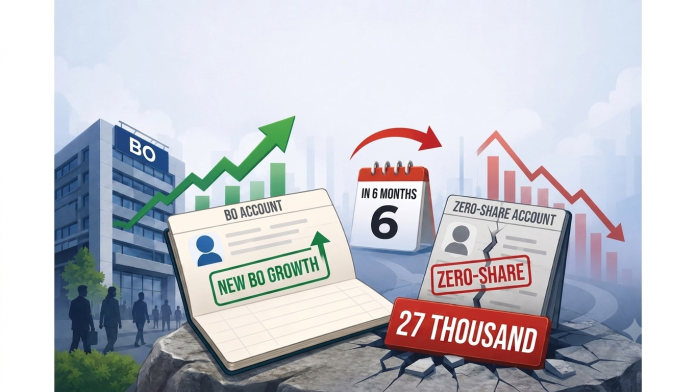
Bangladesh’s capital market added nearly 35,000 new Beneficiary Owner (BO) accounts during the first six months of 2026, but at the same time, around 27,000 accounts became shareless, raising questions about the pace of growth in active investor participation.
According to data from the Central Depository Bangladesh Ltd. (CDBL), the total number of BO accounts increased to 1,675,252 at the end of June from 1,640,558 on January 1, an increase of 34,694 accounts, or about 2.1%.
However, the number of BO accounts with no share holdings rose to 394,816 from 367,617, meaning 27,199 additional accounts became shareless during the six-month period.
Unused BO accounts also increased by 9,454, reaching 76,800 by the end of June from 67,346 at the beginning of the year.
Market participants said that while a rise in BO accounts generally signals growing investor interest, the simultaneous increase in shareless and inactive accounts suggests that many investors either exited the market or stopped trading, leaving uncertainty over whether the number of active investors has grown at the same pace.
CDBL data showed that BO accounts held by male investors increased to 1,262,789 from 1,233,896, while female-owned accounts rose to 394,118 from 388,855. Corporate BO accounts also increased to 18,345 from 17,807.
Individual BO accounts climbed to 1,215,285, while joint accounts edged up to 441,622.
Domestic investor accounts rose to 1,613,724, whereas non-resident Bangladeshi (NRB) accounts declined slightly to 43,118 from 43,549.
Md. Ashekur Rahman, Managing Director of Midway Securities Ltd., said the market’s upward trend during the first half of the year encouraged new investors to open BO accounts. However, many inactive accounts were closed after June 30 to avoid the annual maintenance fee, while the absence of major initial public offerings (IPOs) in recent years also reduced the need to keep IPO-focused accounts active.
CDBL Managing Director and CEO Abdul Motaleb said some investors booked profits and exited the market, while others transferred their shares from defaulted brokerage houses or closed inactive accounts to avoid maintenance charges. He added that new IPOs and a positive market outlook could encourage more investors to open BO accounts in the future.
Capital market analyst and University of Dhaka accounting professor Al-Amin said the increase in shareless accounts does not necessarily indicate a decline in investor interest, as many investors transfer their holdings between brokerage houses or temporarily remain out of the market after selling shares. He noted that rising BO accounts and shareless accounts can reflect different investment behaviors rather than the same market trend.

 accounts during the first six months of 2026,)