

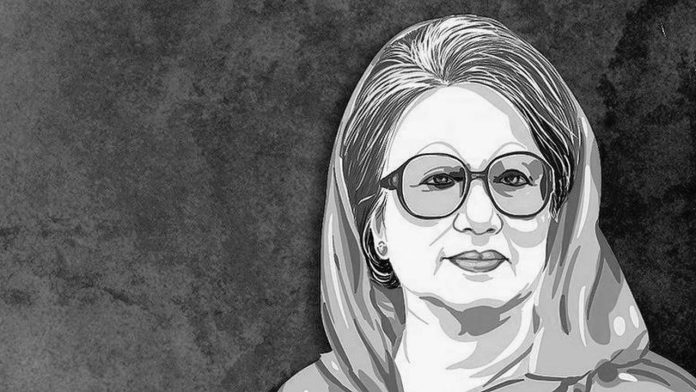
B Mirror Report : BNP Chairperson and three-time former Prime Minister Begum Khaleda Zia has passed away (Inna Lillahi wa Inna Ilaihi Raji’un). She breathed her last at 6:00 a.m. on Tuesday (30 December).
This information was shared in a post on the BNP Media Cell’s Facebook page.
Meanwhile, a post on the BNP’s verified Facebook page stated:
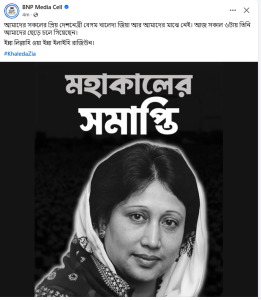
“BNP Chairperson and former Prime Minister, national leader Begum Khaleda Zia, passed away today at 6:00 a.m., just after the Fajr prayer. Inna Lillahi wa Inna Ilaihi Raji’un. We pray for the forgiveness of her soul and request everyone to pray for her departed soul.”
Khaleda Zia had been undergoing treatment at Evercare Hospital in the capital since 23 November. Her personal physician and BNP Standing Committee member Dr. A Z M Zahid Hossain had earlier said that her condition was extremely critical and that she was passing through a very dangerous phase while receiving treatment in the ICU.
Begum Khaleda Zia was born on 15 August 1945 in Dinajpur district. Her father was Iskandar Majumder and her mother was Tayeba Majumder. She studied at Dinajpur Government Girls’ High School in her childhood and later at Surendranath College. In 1960, she married Ziaur Rahman. While Ziaur Rahman was President of Bangladesh, she served as First Lady, meeting world leaders and engaging in various social activities.
After the martyrdom of President Ziaur Rahman in 1981, she entered politics at a critical time for the party. Her political journey formally began on 2 January 1982 when she joined the BNP as a primary member. She later became the party’s Vice-Chairperson in 1983 and was elected Chairperson in 1984.
During the 1980s, she led the movement to restore democracy against the then military autocrat H. M. Ershad. Due to her uncompromising struggle, she earned the title of the “Unyielding Leader.” During this prolonged movement, she formed a seven-party alliance and declared firmly that she would not participate in any election until the fall of the autocratic regime. Throughout this struggle, she was arrested and placed under house arrest seven times between 1983 and 1990.
On 27 February 1991, she won a free and fair election and became Bangladesh’s first female Prime Minister. During her tenure, parliamentary democracy was restored in the country. As Prime Minister, she introduced revolutionary changes in the education sector, including compulsory primary education, free education for girls up to the tenth grade, and stipend programs. She also raised the age limit for entry into government service from 27 to 30 years.
Although the BNP lost the June 1996 election, she served as Leader of the Opposition with 116 seats. In 1999, she formed a four-party alliance and returned to power with a landslide victory in the 2001 general election. In 2005, Forbes magazine ranked her 29th on its list of the world’s most powerful women.
Begum Khaleda Zia holds the unique record in Bangladesh’s parliamentary history of never losing an election in any constituency she contested. From 1991 to 2008, she won every seat she ran for. In 2011, the New Jersey State Senate of the United States honored her with the title “Fighter for Democracy” for her contributions to democratic values.
In 2018, she was sentenced to prison in a controversial verdict. However, according to international and domestic legal experts, the case was politically motivated, and Amnesty International raised questions about the transparency of the trial. Later, following the July 2024 mass uprising and the fall of the Sheikh Hasina government, the BNP Chairperson was acquitted in all cases one by one.


.)