

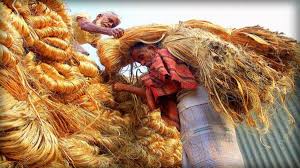
Raw jute has almost completely disappeared from local markets despite recent government limits on its export, making it impossible for mills to find suppliers.
After the main trade season, the government imposed restrictions on raw jute exports due to a notable price spike in August and September.
According to the Directorate of Jute (DoJ), farmers were previously paid fair rates of Tk 3,400–3,700 per maund from August to mid-September, but prices have since increased to Tk 4,300–4,500 per maund.
This abrupt price increase and market scarcity is concerning for jute mills, which are prepared to commence production. Numerous factory owners characterize the current situation as the most challenging in years, with raw materials becoming scarce despite it being the peak jute season.
The Bangladesh Jute Spinners Association (BJSA) convened an emergency meeting last week with the Bangladesh Jute Mills Association (BJMA) to explore solutions for the raw jute crisis, fluctuating prices, and restricted supply.
BJSA Chairman Tapas Pramanik informed The Financial Express that there is unhealthy competition to stockpile jute. “Genuine mill owners are unable to procure sufficient jute to fulfill their production requirements. This instability has plunged the jute industry into significant distress.”
Former BJSA chairman Md Zahid Mian warned that if the current trend persists, prices could exceed the 2021 peak of Tk 6,200 per maund, a time when the country experienced a 30 percent market loss.
“During that time, polypropylene yarn became more popular as buyers moved away from costly jute products. The use of regenerated cotton yarn in carpets has also risen, as cotton rugs are more convenient to fold,” he noted.
Another mill owner asserted that numerous individuals, including several family members, were acquiring new licenses solely to hoard jute. “This practice must cease,” he stated.
“According to Section 17 of the Jute Act, no individual may store more than 1,000 maunds for a month. However, millions of maunds have been stockpiled over the last two months. The law is not being enforced.”
BJMA Chairman Abul Hossain stated, “The jute industry requires enhancements in infrastructure and measures to combat corruption. The government ought to establish a modern data center and a specialized jute commission, akin to those in neighboring nations.”
He also called on the government to implement a fixed minimum price for raw jute, similar to what is practiced for other agricultural products, ensuring that prices reflect production costs.
“If not, it will be challenging to compete in export markets,” he cautioned.
“Should the mills operate without jute, millions of workers will face unemployment, production will cease, and Bangladesh will forfeit foreign exchange revenues,” remarked BJSA Chairman Tapas Pramanik.
Both BJSA and BJMA have requested a total prohibition on raw jute exports until the domestic market achieves stability.
In the meantime, statistics from the Export Promotion Bureau (EPB) indicate that exports of jute and jute products have been on a downward trend since FY21.
Export revenues from this sector were recorded at $1.16 billion in FY21, $1.13 billion in FY22, $911.51 million in FY23, $855.23 million in FY24, and $820.16 million in FY25.


