

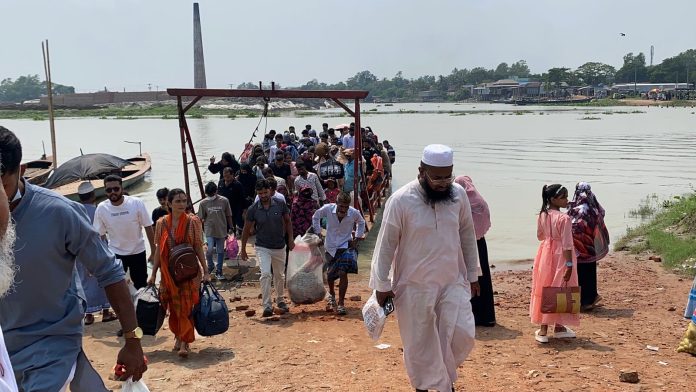
Salahuddin Munshiganj Correspondent: Every morning and evening, thousands of people from Keraniganj and Munshiganj risk their lives crossing a branch of the Dhaleshwari River. Their only hope: a makeshift ferry that locals call a “death trap.” This small vessel carries people, auto-rickshaws, rickshaws, motorcycles, and other light vehicles across the river. A light shower or nightfall turns each crossing into a gamble with life.
During Eid and other festivals, opportunists take advantage of the increased crowd by doubling fares—from 10 taka to 20 per person. Transporting small vehicles can cost over a hundred taka. At night, when there’s no alternative, fare collectors resort to emotional blackmail to extract extra charges. Behind all this lies an unfulfilled dream—the Mollabazar Bridge.
In 2018, construction began on a 252-meter bridge linking Keraniganj and Sirajdikhan. It was scheduled for completion within five years. Yet in 2025, the bridge still seems like a distant reality. Only eight pillars and a few spans of the main structure have been installed—most of the work has remained stalled for years.
The original contractor, Surma Enterprise, abandoned the project midway, causing the 330-million-taka project to come to a halt. A new contractor was later appointed, but issues with land acquisition and other bureaucratic complications have prevented progress. An additional 160 million taka has been requested, but in reality, there has been little to no advancement on the ground.
As a result, nearly 10,000 people remain dependent on the risky ferry crossing every day. Their time, money, and safety are all at stake. Locals allege that hidden interests—such as maintaining ferry operations and controlling land prices—as well as administrative negligence, are behind the prolonged delay of this small bridge project.
Arifur Islam, a local resident, remarked, “A massive project like the Padma Bridge was completed in seven years, yet this small bridge is stuck even after the same time. Is this a failure, or a deliberate delay?”
Once operational, the bridge would allow people from Munshiganj Sadar, Sirajdikhan, Louhajang, and Tongibari upazilas to reach Dhaka in just 30 minutes. It would boost trade, raise land values, and drive local development. But all of that potential remains locked behind the unfinished bridge.
Now, locals have only one demand—no more promises. They want swift completion and immediate opening of the Mollabazar Bridge. Otherwise, yet another generation will drown in the floating misery called the ferry.

