

Liquidity crisis and lack of confidence among investors are being blamed for the recent fall in the country’s capital markets. Due to the increase in interest rates in recent times, the concerned people think that the investment is moving away from the capital market. Moreover, there was a tendency in the past to retain the index on the part of the regulatory body, which is not being done by the regulatory body at present. In this situation, the inevitable consequences of irregularities, corruption and manipulation in the capital market in the past have become clearer than before, according to a notification issued by the Ministry of Finance recently. In this situation, the issue of payment of Tk. 3000 crore to the state-owned investment institution Investment Corporation of Bangladesh (ICB) as liquidity support for investment in the capital market is underway.
During covid, the country’s capital market fell to 3 thousand 600 points. Since then, there has been a gradual upward trend and in September 2021, the overall index of the Dhaka Stock Exchange (DSE) DSEX exceeded 7,300 points. However, since then, the country’s capital market fell into a downward spiral. Sometimes due to Russia-Ukraine war, sometimes economic crisis, sometimes dollar crisis, instability has been seen in the capital market. It was expected that the capital market would turn around at the beginning of this year after the national elections. In the beginning, such a trend was also seen for a few days. However, after the withdrawal of the floor price, the stock market returned to the downward trend from February this year. After the fall of the Awami League government on August 5, there was renewed hope among the capital market investors. The effect of which can be seen in the next several days of trading. However, the capital market has been stuck in the circle of decline since a few days later.
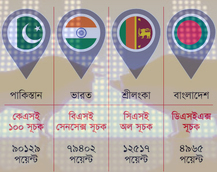
Last yesterday, the country’s capital market fell by about 3 percent and at the end of the day, the DSEX index stood at 4,965 points. The stock market has lost more than 1,000 points in the last two and a half months after the interim government took over. 517 points. Although the level of economic crisis is less compared to the two countries, the opposite picture is seen in the capital market of Bangladesh. The stock market of the country has reached its lowest level since the Covid-19 yesterday due to the continuous fall in prices.
Two South Asian countries, Pakistan and Sri Lanka, were on the verge of bankruptcy in the face of multifaceted economic crisis. They had to approach the International Monetary Fund (IMF) to avoid bankruptcy. Both the countries have brought some stability to the economy through various reform programs. Which has a positive impact on the capital markets of Pakistan and Sri Lanka. Currently, Pakistan’s capital market is at the highest position in history. KSE-100 index stood at 90 thousand 129 points at the end of last October 25. The Sri Lankan capital market is also going in the same direction. At the same time CSEL index stood at 12 thousand
ICB Chairman Professor Dr. Abu Ahmed told the press, “Issues like increase in policy interest rate, decrease in GDP growth projection, exports and reserves have played a role in the downward trend of the capital market. Margin lending also has an impact on the market. ICB has asked the government for a fund of TK. 3 thousand crores. This is not a lot of money for the capital market. However, if ICB starts investing after receiving this money, other investors will also come forward.
After inflation and the dollar crisis peaked, public discontent arose in the island nation of Sri Lanka. As a result of which the Raja pakse government had to leave. The country then took loans from the IMF to overcome the economic crisis and started implementing various reform programs, the benefits of which are currently being seen. Recently, inflation has come under full control in the country. Last September, the country’s inflation was negative 5.5 percent. Along with the economy, Sri Lanka’s capital market is also on a positive trend. However, the country still has a huge debt burden. But despite this, its economy and capital markets are moving in the right direction. Sri Lanka’s CSEL index rose to 13 thousand points in January 2022. After a slight correction, it is in an upward trend. The CSEOL index stood at 12,517 points on October 25.
DSE Brokers Association of Bangladesh (DBA) President Saiful Islam told Media, “Pakistan, Sri Lanka and Bangladesh have similarities in terms of political instability, debt burden, change of government.” There is only one aspect that Bangladesh does not have in common, that is good governance. There was no shortage of good governance in the capital markets of Pakistan and Sri Lanka. The chairman of BSEC did not run away like us. There is no precedent in the history of the world that the head of the capital market regulator has ever escaped. Is it visible that the good governance situation is improving now? People are not buying shares even when they are undervalued. The capital market will turn itself around at some point, that is a different matter. In the past, what to do to solve capital market problems and bottlenecks has always been seen through the lens of regulatory agencies. It seems that this trend has not changed even now. To solve the problem of capital market, it is necessary to discuss with the stakeholders from the higher level of the government.
Pakistan is going through a tough time economically. The country was on the brink of bankruptcy at one point due to the economic crisis. The country did not have the money to buy much-needed fuel. Pakistan finally approached the IMF to get rid of this situation. In this situation, the IMF agreed to give the country a loan of 3 billion dollars in July last year. It has brought some relief to the country’s economy. The country’s stock market index rose by more than 2,400 points in a single day last year on the news of loan approval. According to Bloomberg’s observations, Pakistan’s stock market was the second best in the world at that time. This upward trend of the country’s capital market is still visible. Last October 25, Pakistan’s benchmark index KSE-100 crossed a record high of 90,000 points.
Chairman of DSE Mominul Islam told the press, “The financial sector of Pakistan and Sri Lanka is being managed with great professionalism. But here we have some decisions taken for cheap popularity along with condoning irregularities on the part of the regulatory body. As a result of this, the deep wounds that have been created cannot be removed so quickly. Moreover, when Sri Lanka faced economic problems, they recognized it and undertook reforms to solve it in time. The result of which they are getting now. But we have a very late reform initiative here. As a result, in many cases the desired results are not coming. The economy is expected to see some positive impact of the reforms over the next few months. Until then, you have to be patient. Investors tend to be emotional in the stock market. In this regard, to remove the fear that has been created among them at present, there is a need for reassuring initiatives on the part of the government and regulatory bodies through communication. Apart from this, some policy measures like tax exemption on capital gains can play a role in restoring the confidence of investors as an accelerated initiative.
The capital markets of neighboring India are currently showing some bearishness due to the tendency of foreign investors to sell their shares. But overall, the country’s capital market is in a positive trend in the long term. In August this year, the BSE Sensex index crossed a historical high of 84,000 points. Last October 25, the position of the index was 79 thousand 402 points.
Market participants say that due to the violent cycle of manipulation in the country’s capital market, investors are also interested in junk shares. Many have flocked to these shares following the cycle of manipulation. Currently, the changing situation is somewhat distant from the member markets of the manipulative cycle. In this situation, there is some liquidity crisis in the market. On the other hand, many have taken margin loans to invest in junk shares. In this situation, investors who have taken margin loans are in more panic due to the fall in share prices. Force sale is also happening in some cases. In this situation, investors panic and sell their shares. In many cases no buyers can be found for selling the shares.
After the political change in the country last August, there was a controversy over the appointment of the top leadership of the capital market regulator Bangladesh Securities and Exchange Commission (BSEC) and board members of the main capital market DSE. The impact of which fell on the capital market at that time. Investors were expecting momentum to return to the capital market after the formation of the new commission of BSEC and the new board of DSE after several rounds of changes. They thought that a new wave of bullishness would be seen in the capital markets. However, their expectations were not fulfilled due to the continuous price decline.
When asked, BSEC’s former chairman Farooq Ahmed Siddiqui told Press, “It has been only two and a half months since the interim government assumed responsibility. The law and order situation has not completely returned to normal yet. As a result, it will take some time for investors to regain confidence. As our revenue is low, the government has to continue to borrow money through treasury bills and bonds, which has pushed up interest rates. In this situation, institutional investors are turning to bonds as safe investments instead of capital markets. This has reduced the supply of liquidity in the market. Another issue is that the new leadership of BSEC has no experience with capital markets. They need to understand that this is not a bank, but a capital market. Here we have to proceed with a cooperative attitude with the market players. But it seems that the Commission has moved into a conflicting position with them after taking over. I think the manipulation cycle has exploited this opportunity. The works which the commission has undertaken to do within one-two months would have been implemented in six months. As a result, investors have also fallen into a dilemma. In this case, it was better to proceed slowly.

