

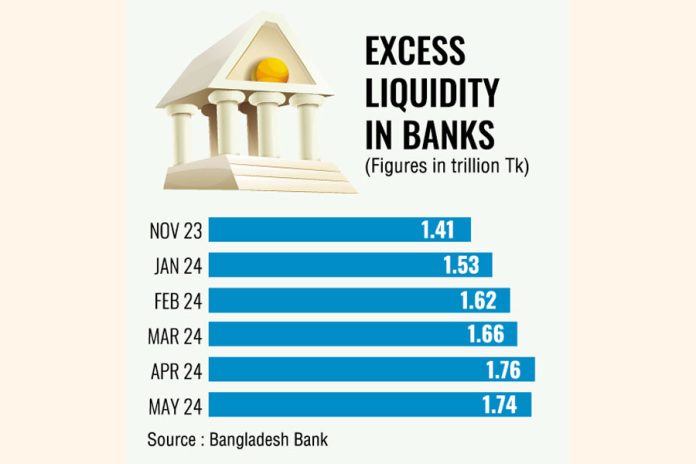
Surplus is now seen in the banking sector of Bangladesh which is suffering from liquidity crisis. According to the data of Bangladesh Bank, excess liquidity in the bank account is Tk. 1 lakh 90 thousand crores. This change is believed to be due to increased confidence of depositors following the recent political changes in the country.
Despite renewed confidence, private credit growth fell to 9.46 percent year-on-year in August 2024. And this has played a role in increasing liquidity in banks.
According to the latest data from the central bank, 46 banks currently have excess liquidity. Out of which there are four Shariah-based and 42 conventional banks. Among these, Sonali Bank is at the top of the surplus fund. It is followed by Agrani Bank, Rupali Bank, Janata Bank and Bangladesh Development Bank (BDBL).
According to Bangladesh Bank sources, depositors are giving more preference to public sector banks than private institutions. Because they feel that their hard earned money is more secure in these institutions. As a result of this change, deposits in government banks increased. In contrast, the status of several Sharia-based banks is less favorable.
Several depositors withdrew their funds from these institutions after large conglomerates like the S Alam Group acquired several banks. Some Shariah-based and conventional banks are facing liquidity crisis due to large scale loan defaults against groups like S Alam, Beximco and Sikdar Group.
A senior official of Bangladesh Bank mentioned that overall the banking sector is stable. Most banks retain sufficient liquidity for investment.
Policy implications on private lending
Bangladesh Association of Banks (BAB) Vice President Muhahad Abdul Mannan said the contractionary monetary policy of Bangladesh Bank, which aims to control inflation, can be blamed for the decline in private credit growth.
High interest rates and fluctuating local currency exchange rates have also discouraged entrepreneurs from looking for new investment opportunities. As a result, many banks invested their excess liquidity in government bonds and bills.
Mannan, who served as managing director of Islami Bank before its acquisition in 2017, said banks are turning to safer investments in treasury bills and bonds due to stagnation in private sector credit disbursement.
Banking stability
Syed Mahbubur Rahman, managing director and chief executive officer of Mutual Trust Bank Plc, said that most of the country’s banks have sufficient liquidity. As demand for private sector credit has waned, many are turning to investing in treasury instruments following standard banking practices.
Mahbubur Rahman also said that as cash in circulation outside the bank is decreasing, deposits are increasing due to high competitive interest rates.
Bangladesh Bank Executive Director and Spokesperson Husneyara Shikha said that strong financial institutions are providing financial support to weak banks. As a result, the central bank stopped printing money to provide liquidity support to failing banks. That is why the overall stability of this sector prevails.rs


