

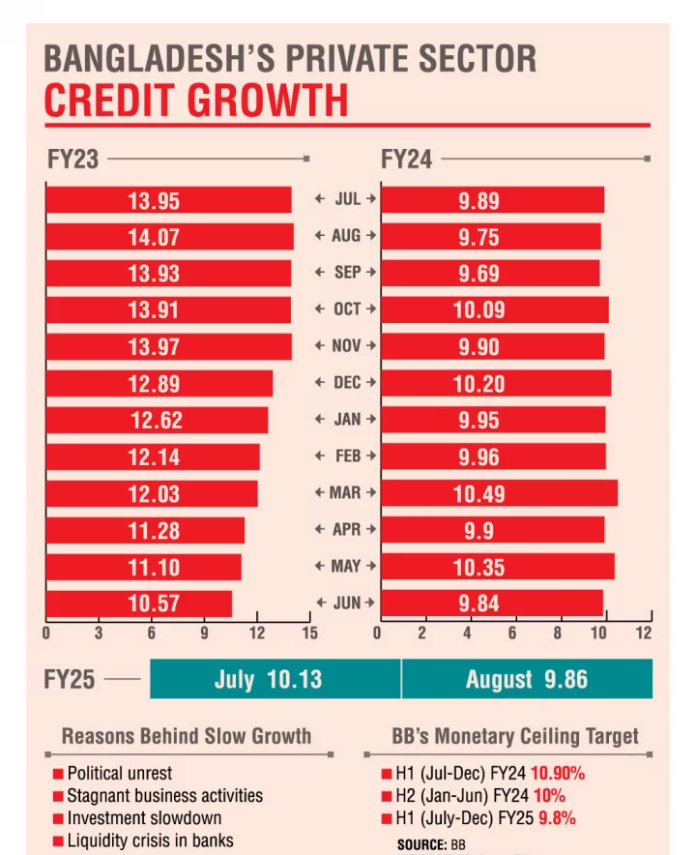
The private sector, the lifeblood of the country’s economy, creates thousands of jobs every year. National production depends on this sector. However, since November 2022, private sector credit growth has been declining consistently.
In October, growth slowed to 8.30 percent. This is the lowest in the past 40 months. Earlier, the lowest growth was 7.55 percent in May 2021. This information has emerged from the Bangladesh Bank report.
Sector-related people said that the dollar market has been unstable for the past two years due to the wrong policies of the Awami League government. During this time, the dollar price reached 85 to 120 taka. This has led to a continuous increase in the dollar rate. As the dollar price has increased, businessmen are also making various calculations when importing. And because of this, private sector credit growth has been declining since then.
On the other hand, private sector credit is declining due to the recent political instability and the upward trend in bank loan interest rates.
According to economists, the political situation has not yet stabilized after the mass uprising in July-August. In this uncertain environment, new investments are not happening. Again, the policy interest rate is continuously increasing to control inflation. This has led to a significant increase in bank loan interest rates. Therefore, businessmen are reluctant to invest in high-interest loans, which has also reduced the growth of the private sector.
According to Bangladesh Bank data, the bank sector’s loan balance in October this year stood at 16,56,202 crore taka. In the same period last year (October-2023), it was 15,29,319 crore taka. The growth in one year has been 8.30 percent. Although in October 2023, there was a growth of 10.09 percent compared to the same period of the previous year. In September this year, loan growth was 9.20 percent. Accordingly, growth has decreased by 90 points in one month.
During the Awami League government, the central bank announced the monetary policy by reducing the target of private sector loan growth from 10 percent to 9.80 percent to combat inflation. However, after the change of government on August 5, the monetary policy was not changed. Although the policy interest rate has been increased several times.
Private sector credit growth was 8.30 percent in October, 9.69 percent in September, 9.75 percent in August, 9.82 percent in July, 10.57 percent in June, 11.1 percent in May, and 11.28 percent in April. In addition, it was 12.04 percent in March, 12.14 percent in February, and 12.62 percent in January.
Private sector credit growth
In early 2022, private sector growth was above 10 percent. It rose to 14 percent in the same year. Later, as the inflation rate continued to rise, the policy interest rate repo was increased to reduce it. More contractionary steps were taken in monetary policy. As a result, private sector credit growth started to decline again from mid-2023. Now it has decreased to 8 percent. Even then, it is not possible to reduce inflation.
On the other hand, inflation in the country has increased in the recently concluded month of November. Especially food inflation has increased to about 14 percent. According to the Bangladesh Bureau of Statistics (BBS), the country’s overall inflation last month was 11.38 percent. In the previous month of October, the country’s overall inflation was 10.87 percent.
In November, the country’s food inflation was 13.80 percent. Non-food inflation was 9.39 percent. In the previous month of October, it was 12.66 percent and 9.34 percent respectively. In November 2023, food and non-food inflation were 10.76 percent and 8.16 percent respectively.


