

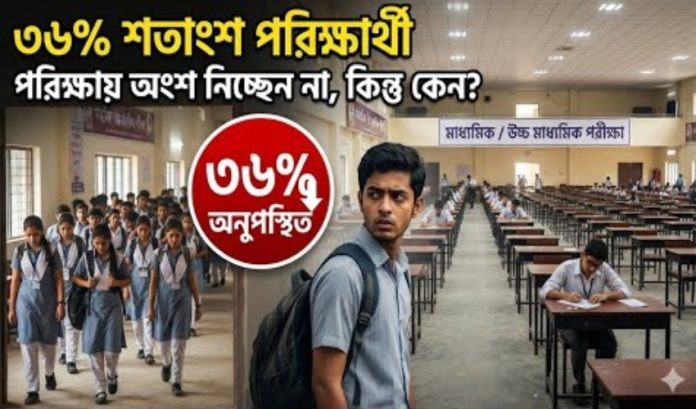
B.Mirror Desk : About 36 percent of regular students did not participate in this year’s HSC and equivalent examinations. According to information from the Ministry of Education and the board, the increase in the absenteeism rate compared to last year has created concern among education stakeholders. At the same time, student irregularity, teacher shortage and management weaknesses are emerging at all levels from primary to higher secondary.
About 9.5 lakh students are participating in the HSC and equivalent examinations under 11 education boards that started on July 2 this year. However, two years ago, about 1.5 lakh students registered for class 11 after passing SSC and equivalent. This means that more than 550,000 students are not participating in the examinations this time, according to relevant sources.
According to education sector data, the absenteeism rate was over 29 percent last year as well. Analysis shows that it has increased by about 7 percentage points in the space of a year. This trend is consistent with the belief that this trend indicates a decline in student participation in higher education.
The situation at the Technical Education Board is even more worrying. This year, more than 54 percent of regular students at this board did not fill out the exam forms.
There is a trend of irregular attendance not only at the higher secondary level but also at the primary and secondary levels. According to a survey, about 60 percent of students at the primary level in rural areas do not attend school regularly, according to sources.
According to the Bangladesh Bureau of Education Information and Statistics (Banbase), there are more than 20,000 secondary schools in the country, of which 702 are government secondary schools.
Although there are 15,293 assistant teacher posts in these schools, about 2,842 posts are vacant, which is about 18 percent of the total. In addition, 383 head teacher posts are also vacant, which is about 55 percent of government secondary schools. It is also reported that the head teacher post has not yet been created in some schools.
Education experts believe that the long-standing administrative and teacher crisis is weakening the quality and supervision of education.
In the current 2026-27 fiscal year budget, the allocation for the education sector has been increased to about 2 percent of GDP. The total allocation has been estimated at Tk 1,36,606 crore, which is about Tk 49,400 crore more than the previous year.
The Finance Minister has mentioned education and human resource development as the ‘core focus’ of national progress in his budget speech. However, a section of experts say that not only increasing allocations, but also practical management and quality improvement are essential.
According to some analysts and columnists, irregularities in the education system, student apathy, and administrative weakness have increased in recent years. They cite various political changes, post-movement situations, and environmental changes in educational institutions as reasons for this trend.
However, there are differences of opinion regarding these claims and explanations. Another side believes that economic pressures, job insecurity, differences in the quality of education, and long-term structural weaknesses are the main reasons.
The country’s education sector is facing challenges, with declining student attendance and participation from primary to higher education, teacher shortages, and weak management, according to those concerned. According to education experts, a coordinated effort is needed to ensure sustainable development in terms of education quality, environment, and policy implementation.


