

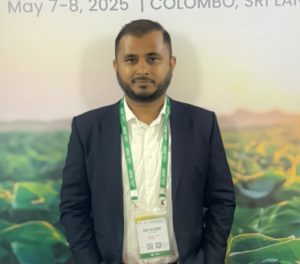
B.Mirror Report: Agriculture has always held a magnetic pull for Bangladesh’s white-collar professionals — a longing to return to roots, to earn without the grip of bank interest, and to contribute something tangible to the nation’s food basket. It is precisely this innocent yearning that an online-based investment outfit called AgriVenture appears to have weaponised against hundreds of ordinary savers, allegedly channelling their hard-earned money into a classic Ponzi scheme disguised as farm-project investing. At the centre of the storm is co-founder and chief executive officer Rabib Ridwan, son of former Central Women’s College principal Lutfor Nahar and a retired personnel from Proshika, Somaj Uddin, who was born in 1988 in Mohammadpur’s Jafarabad area of the capital.
 According to documents and testimony gathered from thirteen individual investors whose complaints have appeared in various newspapers, AgriVenture offered investment packages ranging from Tk 40,000 to Tk 6–7 lakh in vegetables, rice, potato, onion and fish farming projects spread across Bogura, Rangpur, Bagerhat, Khulna, Patuakhali, Jashore and Jamalpur. Each package promised returns of 5 to 13 per cent along with principal repayment in three, five or six months. The website, still accessible as of Friday, 24 April, continues to flash similar eye-catching offers: Bogura maize at 10–12 per cent on Tk 50,000 in six months; Bogura-Rangpur rice at 12–14 per cent on Tk 1 lakh in six months; Bagerhat-Khulna fish at 16–18 per cent on Tk 50,000 in six months; and Patuakhali-Jashore-Jamalpur fish at 13–16 per cent on Tk 60,000 in six months. The company reportedly rolls out new crop-linked packages every year, collecting crores in fresh deposits.
Early on, a handful of small investors did receive their promised dividends along with partial principal — enough to build confidence and trigger a cascade of referrals through social media and LinkedIn campaigns. That initial “gain” is what lured most victims, the majority of whom are corporate employees. At one stage, the promotional buzz even attracted a USD 100,000 fund from GAIN (Global Alliance for Improved Nutrition), a Switzerland-based non-profit that works worldwide with governments and private sectors to eliminate malnutrition by ensuring safe and nutritious food. GAIN runs nutrition, agriculture and food-safety programmes in Bangladesh, and its backing gave AgriVenture a veneer of international credibility that deepened investor trust. At that time, two other partners, one named Rashid and another Shakil, were involved in the venture and had facilitated the foreign funding. Both eventually distanced themselves from the organisation, citing Rabib Ridwan’s repeated ethical breaches.
Victim Ashraful Islam, who now stands Tk 33 lakh 44 thousand 800 in the red, said Rabib first enticed people with modest sums and inflated returns. Once trust was secured, he pressed for larger commitments. “We all chose this because of our soft spot for farming and the desire for interest-free profit. Another reason was the GAIN funding — organisations like that do thorough due diligence before releasing money. Yet the entire deposit is now gone through AgriVenture, and today I am left with nothing,” he said. His is not an isolated case. The thirteen documented complainants alone are owed Tk 2 crore 67 lakh 58 thousand 300. Among them, Ishtiyak Rabbi is owed Tk 1 crore 20 lakh, Mirajul Tk 17 lakh 53 thousand 500, Shahadat Tk 24 lakh, Rajib Kumar Tk 8 lakh 45 thousand, Samiul Tk 35 lakh, Ashraf-2 Tk 2 lakh 85 thousand, Farabi Tk 1 lakh 55 thousand, Simab Tk 3 lakh 17 thousand, Rizwan Tk 10 lakh, Rumjhum Tk 6 lakh, Reza Rana Tk 58 thousand and Rashid Abhi Tk 5 lakh.
The pattern, victims and a former staffer say, is textbook Ponzi: new investors’ money is used to pay off earlier ones. As long as fresh deposits kept flowing, the scheme held. Once recruitment slowed, the edifice began to crack. Over a year now, no dividend or principal has been returned to any of them despite repeated visits to the office and court filings. Ishtiyak Rabbi, who invested Tk 1 crore 20 lakh, filed a case (Criminal Case No CR 568/25) against Rabib Ridwan at a Chief Metropolitan Magistrate court under Sections 406, 420 and 506. On 15 January this year, a warrant of arrest was issued. Rabib later secured bail by claiming he would surrender and return the money. His lawyer Barrister Afroz told this newspaper, “An arrest warrant was issued, and the accused took bail promising a settlement. But he keeps delaying my client’s repayment. If he does not pay, he will land in jail and every legal step including property attachment will follow.” The lawyer added that through further investigation he has learned Rabib took money from over seventy people, amounting to more than Tk 50 crore, and is now stalling on every front.
A former employee, speaking on condition of anonymity, confirmed the figure, estimating outstanding dues at Tk 50–60 crore. Every day, creditors turn up at the office. Once reachable by phone, Rabib has now blocked all their numbers. Those who come to the office are subjected to humiliation and intimidation. The office was shifted from Farmgate to Lalmatia, allegedly out of fear of the crowd, but Rabib reportedly does not attend it anymore — nor does he answer any call. Repeated attempts by this newspaper to reach him on his personal mobile and via SMS drew no response. A WhatsApp message sent to his HR team’s number prompted a query about “what information is needed,” but when specific questions were forwarded, silence followed.
The company, registered as a limited entity, is supposed to have at least two directors. Apart from Rabib Ridwan, only one name — Amirul Arefin — appears on record, but he too is said to be irregular and effectively absent. Meanwhile, the former employee disclosed that new recruits are being hired solely for their ability to bring in fresh investment of Tk 50,000 to Tk 5 lakh each, with a five per cent commission on top of salary — a clear sign the outfit is still chasing deposits to keep the Ponzi cycle turning. A related source further alleged that while dividends remain unpaid, Rabib is quietly spiriting funds abroad.
Commenting on the broader context, Dr Taufiqul Islam Khan, Additional Director (Research) at the Centre for Policy Dialogue (CPD), a leading private research body, said, “AgriVenture-type projects are gaining global popularity, and many urban Bangladeshis are investing in farm schemes. But this sector must be brought under a firm policy and regulatory framework, similar to what we have in banking and capital markets. Unless that happens, fraud will keep recurring — and it will be the agricultural sector’s growth that ultimately suffers.”
For a country that feeds 170 million on smallholder farming and where remittance-weary professionals dream of clean, interest-free rural returns, scams like AgriVenture are doubly cruel. They do not merely steal money — they poison the very idea of citizen investment in agriculture, erode trust in legitimate agri-enterprises and push savers back into the arms of banks and informal lenders. When crores vanish into a single man’s unchecked ambition, the damage is not only financial; it is to Bangladesh’s fragile hope that its cities and villages can grow wealth together on honest soil.

