

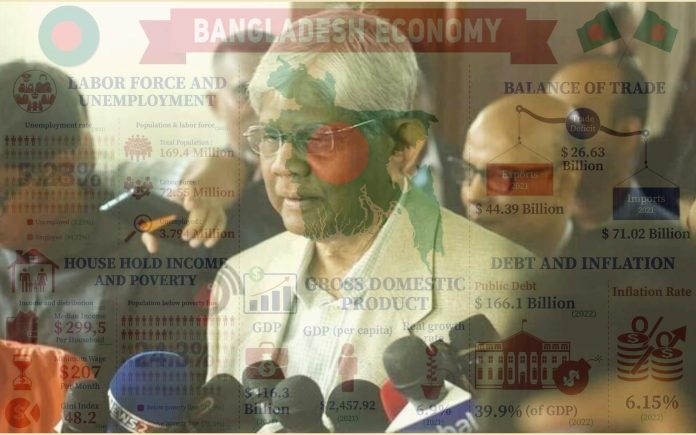
Dr. Salehuddin Ahmed is the interim government’s adviser on finance and trade and science and technology. He was the ninth governor of Bangladesh Bank (May 2, 2004-April 30, 2009). he talked about what steps are being taken to address the existing challenges in the finance and trade sector and what are the long-term reform plans.
Two months have passed since the August 5 student uprising. An interim government has been formed and you are in charge of its important finance and commerce ministries. Our economy has been in turmoil for a long time. What steps are you taking to bring stability?
First, the economy has been somewhat sluggish in the past two months, not stagnant. A few months of agitation had to go through. But in the meantime, there has been momentum in agriculture, small and big industries have been started. There are basically two major challenges before us in fully revitalizing the economy. From the very beginning, we are trying to restore people’s trust. We are working to bring back trust in various sectors including banks, industries, trade and garments. Some steps have already been taken, such as identifying problems in sluggish industries and revitalizing them.
There has been a major improvement in the banking sector. Banks that had problems are being resolved. Under the initiative of Bangladesh Bank, liquidity assistance has been given to weak banks. Public confidence in Islamic banks is also returning. Foreign banks are also becoming aware of Islamic banks in the country.
Administrative reforms in the National Board of Revenue (NBR) are bringing dynamism to the operations. Various steps have been taken to simplify the tax payment process. Nowadays many people are paying tax online as online tax payment facility has been introduced. Recently, due to the labor movement, many companies in the garment sector stopped production. Through discussions with the workers, their demands have been accepted and steps have been taken to pay the arrears. The economy is regaining dynamism, multinational donor agencies are regaining confidence and willing to cooperate.
We have received reports of money laundering earlier, now we are getting more details. What steps are you taking to bring back this huge amount of smuggled money?
Bangladesh Bank and NBR are working together to detect money laundering. In particular NBR is reviewing and investigating tax files of companies. Bank accounts of big entrepreneurs suspected of money laundering and tax evasion have been frozen. However, their business has been kept open, so that there is no stagnation in the overall economy.
Meanwhile, Bangladesh Bank is negotiating with several countries to bring back the smuggled money. So far they have contacted 21-22 countries. A working committee has been constituted by the Ministry of Finance on national issues like money laundering. The Governor of Bangladesh Bank oversees these matters and works with the Bangladesh Financial Intelligence Unit.
The previous economic stagnation has largely subsided. Initiatives have been taken to strengthen every sector of the economy. Measures have been taken in the light of the agreements with various countries on the issue of money laundering. Earlier the Bangladesh Financial Intelligence Unit (BFIU) did not function well. At least no one is worrying about new corruption as every oversight agency is activated. Money laundering through over-invoicing and under-invoicing in import-export or in other ways has reduced.
Oligarch flattery is a major blight on our economy. Big companies are the biggest debtors. Small and Medium Enterprises (SMEs) need to be strengthened to increase employment and grow the economy. What are your thoughts on this?
I have recently spoken to more than thirty bank chairmen. They have been instructed to exercise caution in giving fresh loans. In many cases, the loan is defaulted. As a result we have to save money and debt.
We are saying the word ‘inclusive’ over and over again. But small and medium entrepreneurs cannot stand without financing. It is a major sector of employment. So we asked the banks to change their attitude. Because the incidence of default is very low in the case of small and medium entrepreneurs. Usually in the case of big entrepreneurs there are cases of default and in this case the amount of money is also big. On the other hand, Bangladesh Bank has also been asked to re-finance SME loans if necessary.
SME Foundation should be made more effective. SME Foundations must work together by establishing linkages with other organizations such as NGOs, microfinance institutes and banks. The SME Foundation should take the lead in strengthening small and medium entrepreneurs and institutions. Bangladesh Bank also has liability here.
The central bank has raised interest rates several times. Many question the attempt to control inflation by raising interest rates. Inflation is still close to double digits. When do you think inflation can be brought under control?
Inflation fell by 1 percent last month. This is official figure and actual figure. Food prices have started falling. In some cases, eg the price of eggs has gone up. However, there is no logical reason for the increase in the price of eggs. Egg production is more than our demand. The recent floods have reduced production slightly, but the resulting increase in egg prices across the country is unwarranted. Here there are market syndicate and monopoly effects. We are working against it under the Consumer Protection Act. Besides, other ministries and especially wholesale traders should be more careful.
On the other hand, if the interest rate is reduced, only the big entrepreneurs benefit. In this case, the main goal is to balance the loan demand. Large entrepreneurs often borrow in excess of demand, thus raising interest rates to balance.
Increasing the supply of consumer goods is more important than interest rates to reduce inflation. We are working to increase the supply of agricultural products and foodstuffs. Whether additional benefits can be given to suppliers is also being considered. At the same time, importance is being given to market management. Some people import goods, while others stockpile them. We know who is doing it. It is almost impossible to import products without big importers. But those who distribute or supply the goods after import, have some unethical business decisions. In many cases there is a wide gap between the import cost and the selling price in the market. These groups must be regulated for the convenience of consumers.
You have taken several steps in bank and financial sector management. It has also had a visible impact. However, ordinary depositors are facing difficulties in withdrawing cash. Weak banks are also being helped in various ways to overcome the liquidity crisis in the banking sector. By when the liquidity crisis can be reduced?
Overall there is no liquidity crunch. Only banks with management problems, such as some Islamic banks and Padma Bank, are suffering from liquidity crunch. The main reason for this is the past corruption and poor management of these banks. These banks were put under the control of a few individuals through corruption. But the number of such banks is limited. We are providing our best possible support to the customers of such banks. In many cases the checks and pay orders of several of their customers have been honored from Bangladesh Bank. But it is not possible to do it regularly.
A committee has been formed to reform the banking sector. If they bring some visible changes through reforms, relief will return to the banking sector. In the current scenario, customers should also be cautious about accepting checks for large sums of money. Bangladesh Bank must work for the safety of customers of other banks. It is an ongoing process. It will take some time to restore stability in the banking sector. Some banks are in more trouble and management and capital raising decisions have to be made for those banks. We are trying to restore confidence in the banking sector by improving liquidity support and management.

